
Three social responses to the AI opportunity
Authors: Mathijs Leenheer and Ruud Kapteijn
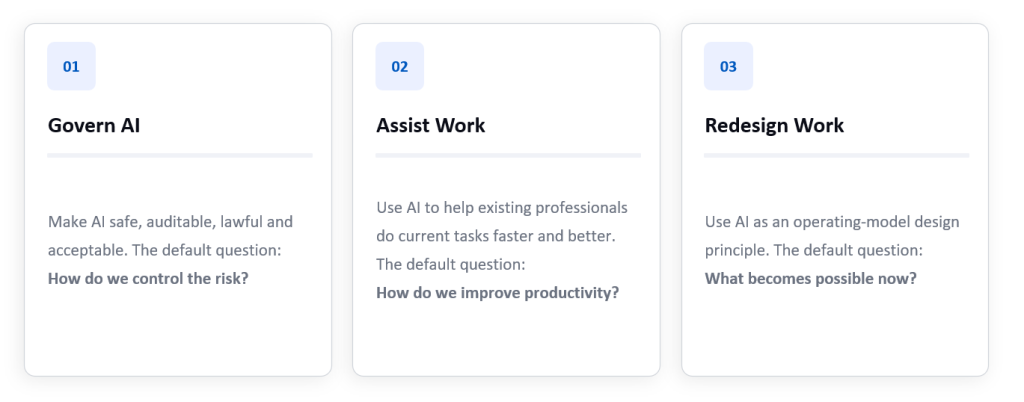
Executive thesis: The AI debate has three legitimate responses. Some leaders focus on trust, risk and governance. Others use AI to make existing professionals faster. Both are necessary. Neither is sufficient. The strategic frontier is Category 3: using AI to redesign the operating model itself.
Why this matters now
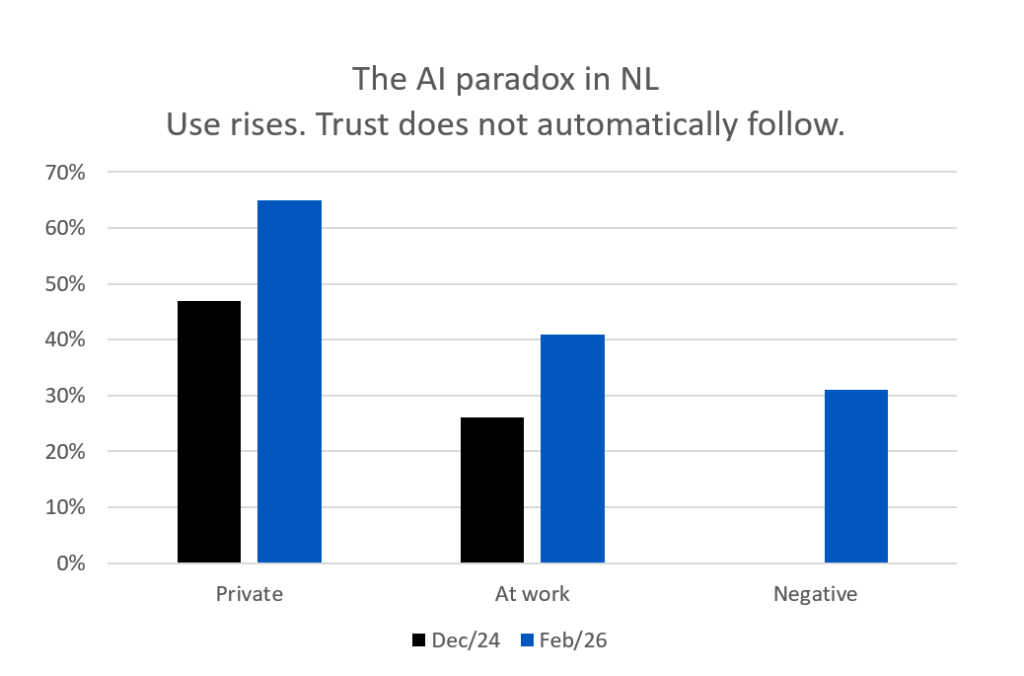
AI adoption is rising while trust remains fragile. The Dutch AI Barometer reports private AI use rising from 47% in December 2024 to 65% in February 2026, and workplace use from 26% to 41%; at the same time, 31% of respondents had a negative attitude toward AI.1 Nieuwsuur captured the same tension in its report on growing AI resistance in the Netherlands.2
That tension is normal. Every general-purpose technology creates resistance, cautious adoption and eventually disruption. The railway did not change the economy by making horses faster. It reorganized distance, logistics, settlement and time.
The same will be true for AI. The companies that benefit most will not merely write policies or buy copilots. They will ask which handovers, roles and process steps still exist only because humans were historically needed to translate intent into action.
1. Guardrails are necessary – but not a strategy
Category 1 deserves a respectful reading. AI can amplify discrimination, invade privacy, produce misinformation, concentrate power, consume energy and disrupt labour markets. The EU AI Act reflects this risk-based view and entered into force on 1 August 2024.3
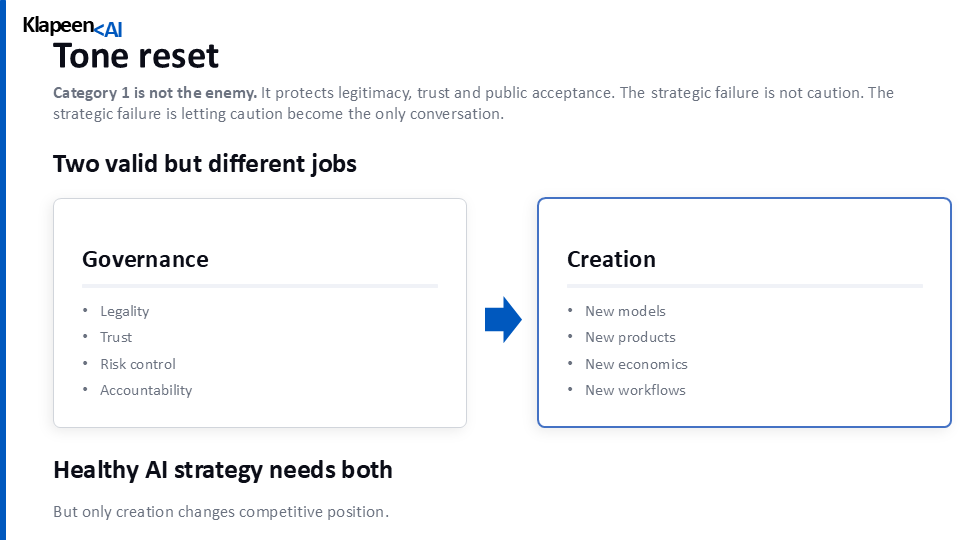
Regulation, audits, responsible AI, model governance and explainability are not obstacles by definition. They are how organisations create trust. In regulated sectors, they are a license to operate.
The risk is different: when governance becomes the whole AI agenda, organisations become excellent at controlling yesterday’s process while competitors design tomorrow’s process.
Historical analogy: the railway
Early railway expansion met serious resistance. Local landowners opposed the Stockton & Darlington Railway, and John Ruskin later opposed railway expansion into the Lake District.4 Many objections were legitimate: safety, noise, land use and landscape damage. But the railway’s economic force was too strong to be stopped by discomfort alone.
The limit of prohibition
Autonomous weapons show the same structural problem. The UN Secretary-General has called lethal autonomous weapons politically unacceptable and morally repugnant.5 Yet Reuters has reported rapid deployment of AI-assisted drone guidance in Ukraine, including systems that keep tracking targets after communication is lost and large deliveries of AI drone kits.6 Where technology creates decisive advantage, governance shapes adoption – but rarely stops it.
2. Productivity is real – but strategically incomplete
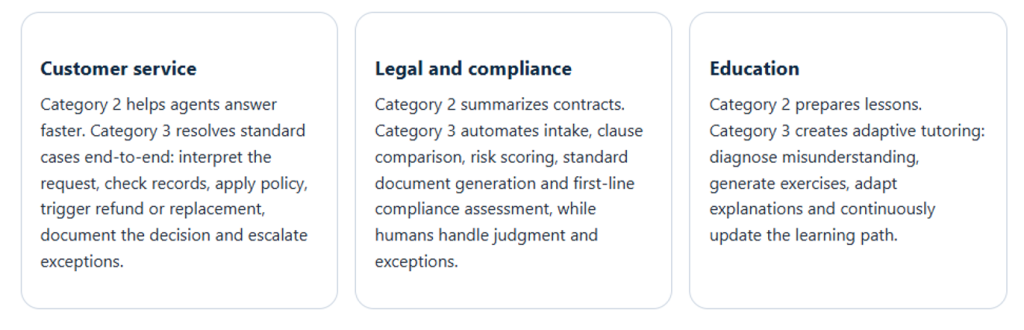
Category 2 is the dominant corporate response because it is useful and psychologically comfortable. Developers use GitHub Copilot. Teachers generate lessons. Consultants draft slides. Analysts summarize documents. Managers prepare meeting notes.
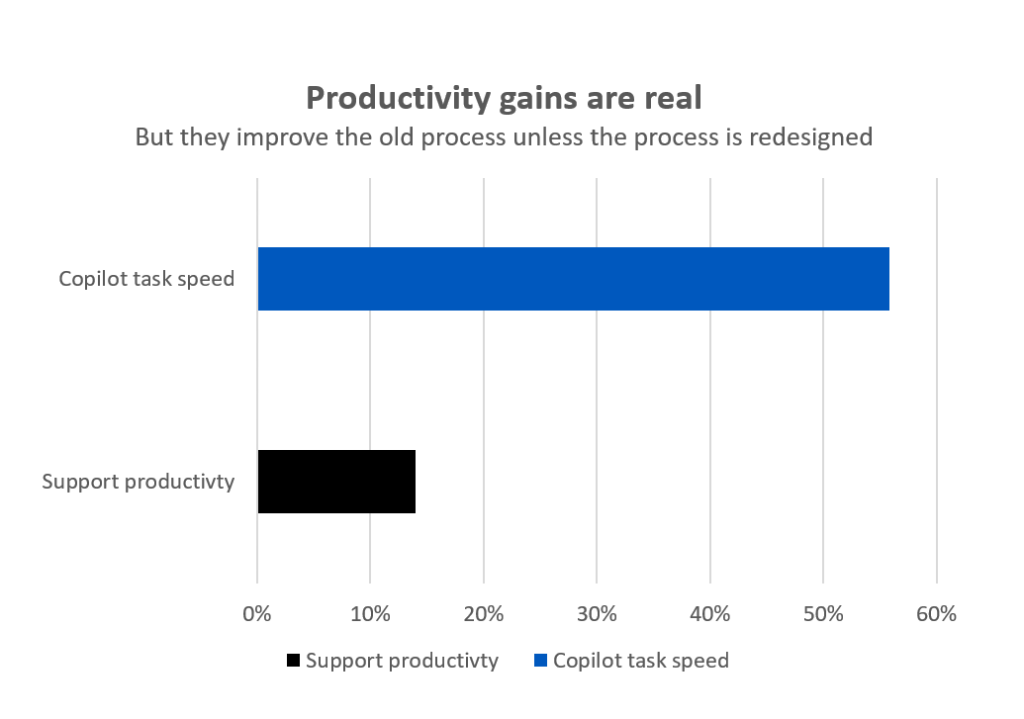
The gains are real. A controlled GitHub Copilot experiment found that developers with access to the AI pair programmer completed a task 55.8% faster.7 In customer support, Brynjolfsson, Li and Raymond found that generative AI assistance increased productivity by nearly 14%, with stronger gains for novice workers.8
But the operating model remains intact. The developer remains a developer. The support agent remains a support agent. The consultant remains a consultant. The process map is still recognizable.
3. Category 3: AI as an operating-model design principle
The disruptive question is simple: which process steps exist only because humans were historically needed to translate, coordinate, specify, code, check or communicate?
Category 3 does not ask how AI can help people perform the current process. It asks what the process should become now that AI can reason over text, data, code, workflows and context.
This is where AI removes or merges steps. Business intent can become an executable workflow. A customer request can become a resolved case. A product idea can become a deployed application. A legal intake can become a risk-scored draft. A care pattern can become an exception alert.
The pattern matches classic disruptive innovation: simpler and more accessible solutions enter from the edge and move upmarket.9 It also aligns with McKinsey’s description of agentic organizations, where humans work with virtual and physical AI agents to create value across operating model, governance, workforce and technology.
The uncomfortable implication for medium-sized enterprises: your future competitor may not be a larger incumbent. It may be a five-person AI-native team with a better process architecture and much lower coordination cost.
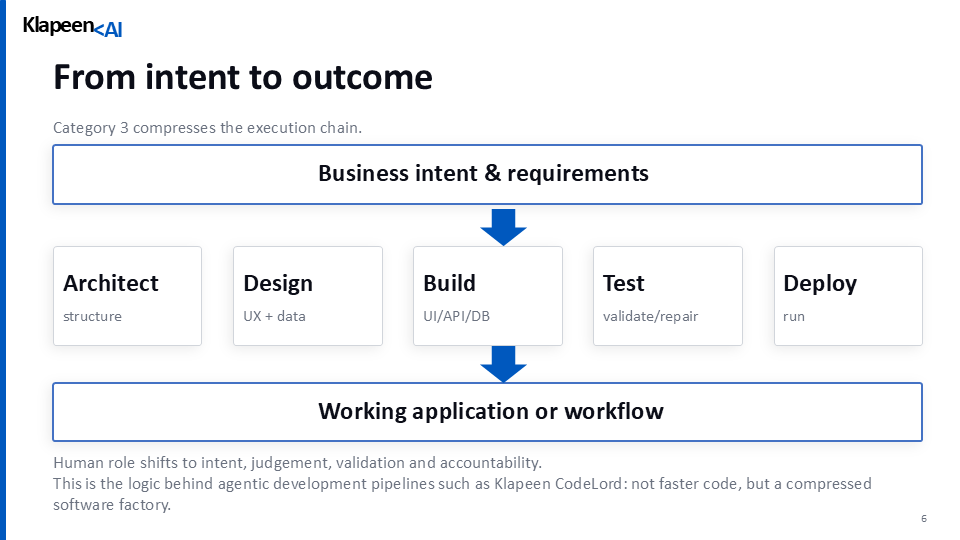
| Software from business requirements Traditional custom development separates business analysis, architecture, UX, database design, API design, coding, testing, deployment and documentation. Category 2 helps developers code faster. Category 3 compresses the chain: specialized agents interpret requirements, design the architecture, scaffold the app, build the UI, write tests, deploy and repair. SWE-bench Verified, a human-filtered set of 500 real software tasks, illustrates how quickly AI agents are moving into real engineering work. | The AI-native software company In the traditional model, a serious software vendor needs separate teams for product, analysis, design, engineering, testing, DevOps, documentation, support, marketing and sales. In an AI-native model, a small expert team defines the promise and constraints while agentic workflows execute much of the production, support and sales enablement. The scarce resources become domain insight, trust, distribution and execution discipline – not headcount. |
4. Category 3 is not only for spectacular AI systems
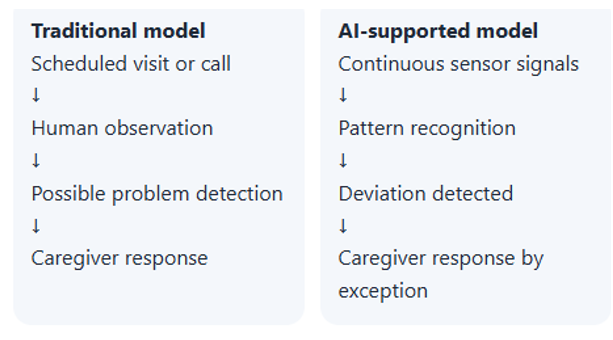
Elderly home monitoring: from scheduled care to exception-based care
Sensara describes smart sensors combined with self-learning software that registers and analyses daily living patterns, notifies caregivers about worrisome situations and raises alarms in emergencies.12
This is Category 3 because the care model changes. Routine checking is partly replaced by continuous, privacy-conscious pattern monitoring and exception alerts. The human caregiver remains essential, but acts when the system detects a deviation.
5. Field observation: AI Salon Amsterdam
AI Salon Amsterdam on 21 May 2026 was hosted at Google Amsterdam and positioned as a networking event for the AI scene, including talks, demo pitches, tables and open networking.13 That is a context where one might hope to hear more Category 3 thinking.
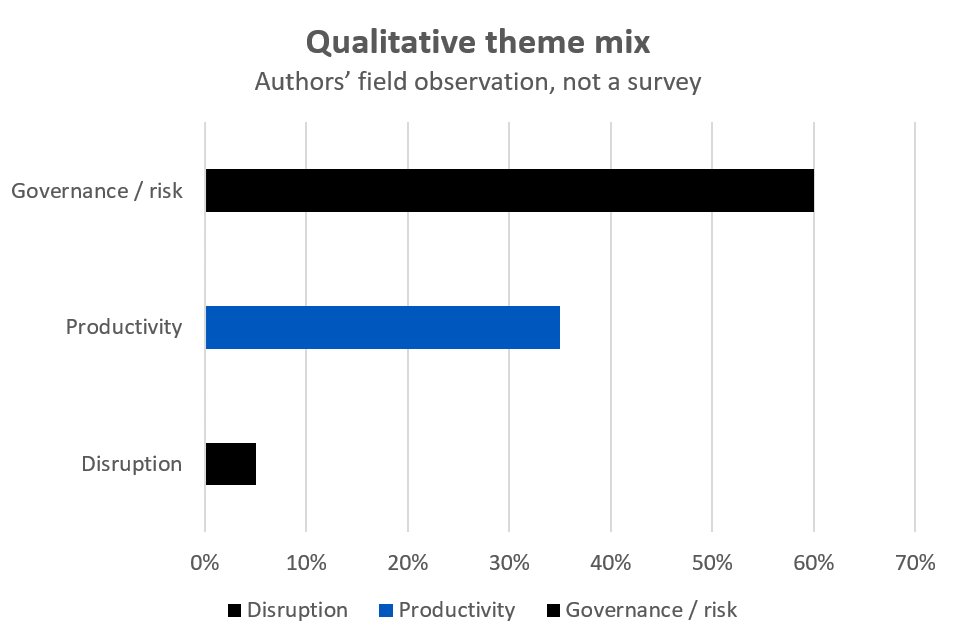
Our observation was different. Compared with international product-leadership forums, the Amsterdam discussion appeared concentrated on risk, governance and productivity. That is not wrong — but it suggests that the operating-model disruption conversation is still underdeveloped locally..
6. What medium-sized enterprises should do next
If your AI strategy only says “safe” and “productive”, you are probably protecting yesterday’s organization.
For medium-sized enterprises, the opportunity is not to imitate big tech. It is to use AI-native design to compete with less overhead, fewer handovers and faster learning cycles.
The first move is not a technology purchase. It is a process redesign exercise. Pick one important value chain and ask what it would look like if AI agents could read, decide, draft, calculate, check, document and trigger actions under human oversight.
| Ask this | Why it matters |
| Which handover exist only because humans had to translate? | These are prime targets for AI compression |
| Which standard customer or internal request can be solved end-to-end? | This reveals workflows, not tools. |
| Which roles require judgement, and which only move information? | Keep humans where trust and accountability matter. |
| What product could a five-person AI-native team launch against us? | This creates useful fear of missing out. |
Conclusion
Category 1 is necessary because AI creates real risks. Category 2 is valuable because productivity gains are immediate and measurable. But Category 3 is where the discontinuity sits.
AI will not be revolutionary because it helps developers code faster, teachers prepare better material or caregivers read dashboards more efficiently. It will be revolutionary because it lets organizations remove or redesign steps that once seemed permanent.
The leadership question is therefore not only: how can we use AI safely? Nor only: how can we use AI productively? The deeper question is: what would our business look like if we rebuilt it around AI from first principles?
Selected sources