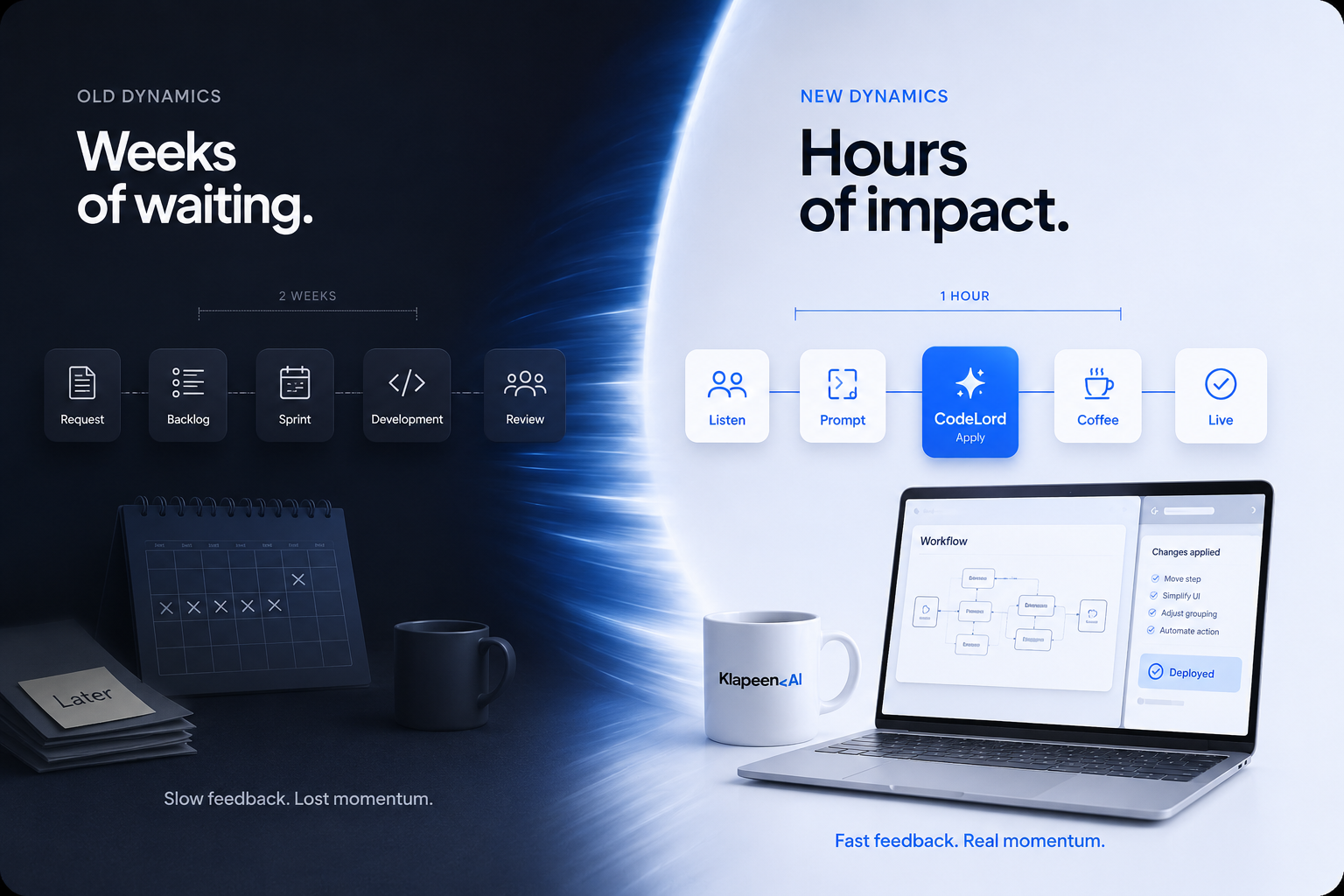
Most companies still think software development works like this:
- Someone has an idea.
- It goes into a backlog.
- A sprint gets planned.
- A developer picks it up.
- A demo happens two weeks later.
- The users say: “Almost what we meant.”
Then the cycle repeats.
Again.
And again.
The strange thing is: everybody involved already knows this process is slow.
Not because developers are lazy.
Not because companies are incompetent.
But because traditional software delivery was designed for a world where changing software was expensive.
That world is disappearing fast.
This week we sat together with a client, reviewing a custom internal tool we built.
Laptop open.
The application on one screen.
CodeLord on the other.
The team suggested a few improvements:
- move a workflow step
- simplify part of the interface
- adjust how information was grouped
- automate a repetitive action
Normally, those kinds of requests disappear into “the next sprint.”
Instead, we typed the changes directly into CodeLord and pressed Apply.
Then we walked to the coffee machine.
We joked:
“Before the coffee gets cold, it’ll be live.”
And it was.
That was the moment the real shift clicked.
Not AI as a gimmick.
Not AI-generated prototypes.
Not innovation theatre.
Actual operational speed.
This changes something fundamental about how software should be built.
When software can evolve in minutes instead of weeks, the relationship between teams and technology changes completely.
You no longer need:
- endless specification documents
- heavy sprint planning
- giant release cycles
- months of waiting for “phase two”
Instead, you can sit with the actual users for thirty minutes, listen carefully, implement changes immediately, grab a coffee, and come back to software that already behaves differently.
That creates a completely different dynamic:
- less friction
- faster adoption
- happier teams
- more experimentation
- better operational fit
And ironically: often less total development effort.
At Klapeen, we increasingly believe the future of software development is not about faster coding.
It’s about faster feedback loops.
The companies that win will not necessarily be the companies with the biggest IT departments.
They’ll be the companies that can learn and adapt operationally faster than their competitors.
Not sprints of two weeks.
Not sprints of one week.
Not even sprints of one day.
Sprints of one hour.
That’s where it gets interesting.
What also makes this shift different for us personally is our background.
Klapeen was not founded by a traditional agency team of developers, architects or marketers trying to “add AI” to existing workflows.
Our background is in operations, product strategy, customer journeys, commercial processes and value creation.
We’ve spent years inside real businesses:
- managing operational teams
- improving customer satisfaction
- optimizing delivery processes
- scaling organizations
- fixing bottlenecks
- understanding where margin leaks away
- translating strategy into execution
That matters.
Because this new generation of AI-powered software development is not primarily a technology challenge anymore.
The real challenge is:
- understanding the business deeply enough
- listening to teams properly
- identifying friction fast
- translating operational reality into working software
- and continuously refining that software together with the people actually using it
The speed of AI changes the role of the software partner completely.
The bottleneck is no longer coding speed.
The bottleneck becomes understanding.
And that is exactly where we feel at home.
At Klapeen, we don’t just build software faster.
We help companies learn how to operate faster.