On eating your own cooking, the limitations of AI in legacy workflows, and what “AI-native” actually means in practice.
At some point, every growing company hits the same wall. For us it was the inbox. As inquiries piled up and conversations with prospects multiplied, the spreadsheets and shared mailboxes that had carried us this far started to creak. Who followed up with whom? What did we promise in that call three weeks ago? Which leads were actually worth our time? We were spending more energy keeping track of the work than doing it.
We needed a real system. So we did what most people do first: we looked at the obvious answers.
The off-the-shelf problem
HubSpot, Salesforce, and the rest are capable platforms, and for plenty of companies they’re the right call. But two things stopped us.
The first was cost. The price of a serious CRM — once you add the seats, the tiers, and the add-ons you actually need — climbs quickly, and it keeps climbing as you grow. For a lean team, a lot of that spend buys features you’ll never switch on.
The second was more fundamental, and it’s closer to home for us. We want a CRM solution which includes AI natively in the CRM processes. Not just improve efficiency with AI support but AI agents, which take ownership of CRM tasks and processes.
So we built our own
We talk to clients all day about putting AI to work properly. It felt right to put our money where our mouth is. We built Klapeen<CRM — and we built it with our own AI development pipeline, CodeLord, which is its own story for another post.
We were deliberate about one thing from the start: the bones of the system are completely conventional. This is not a science experiment. It’s a CRM, and it works the way you’d expect one to. You get contacts and companies, propositions and campaigns, pipelines and deals, quotations— all the familiar furniture, so anyone who has used a CRM before feels at home on day one.
The difference is what runs underneath all of it.
What “AI-native” means to us
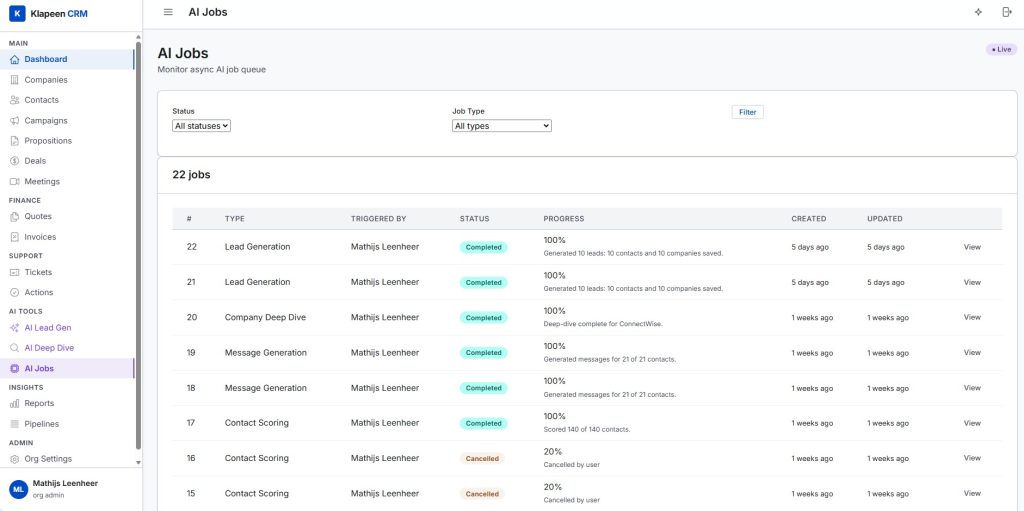
AI-native doesn’t mean a chatbot in the corner. It means the AI is woven into the daily work — the prospecting, the research, the follow-up — rather than parked in a separate menu. Here are the four places where it earns its keep in Klapeen<CRM.
Turning your network into a ranked outreach list. Most of us are sitting on a goldmine we never use: our LinkedIn connections. You import that network once, and from then on, when you attach contacts to a campaign, the system scores each one against the specific product or solution you’re selling. It tells you how relevant each person is, why they’re relevant, and hands you a personalized first message ready to send — in the contact’s own language. The same person can be scored completely differently for two different campaigns, because relevance is never absolute; it depends on what you’re offering.
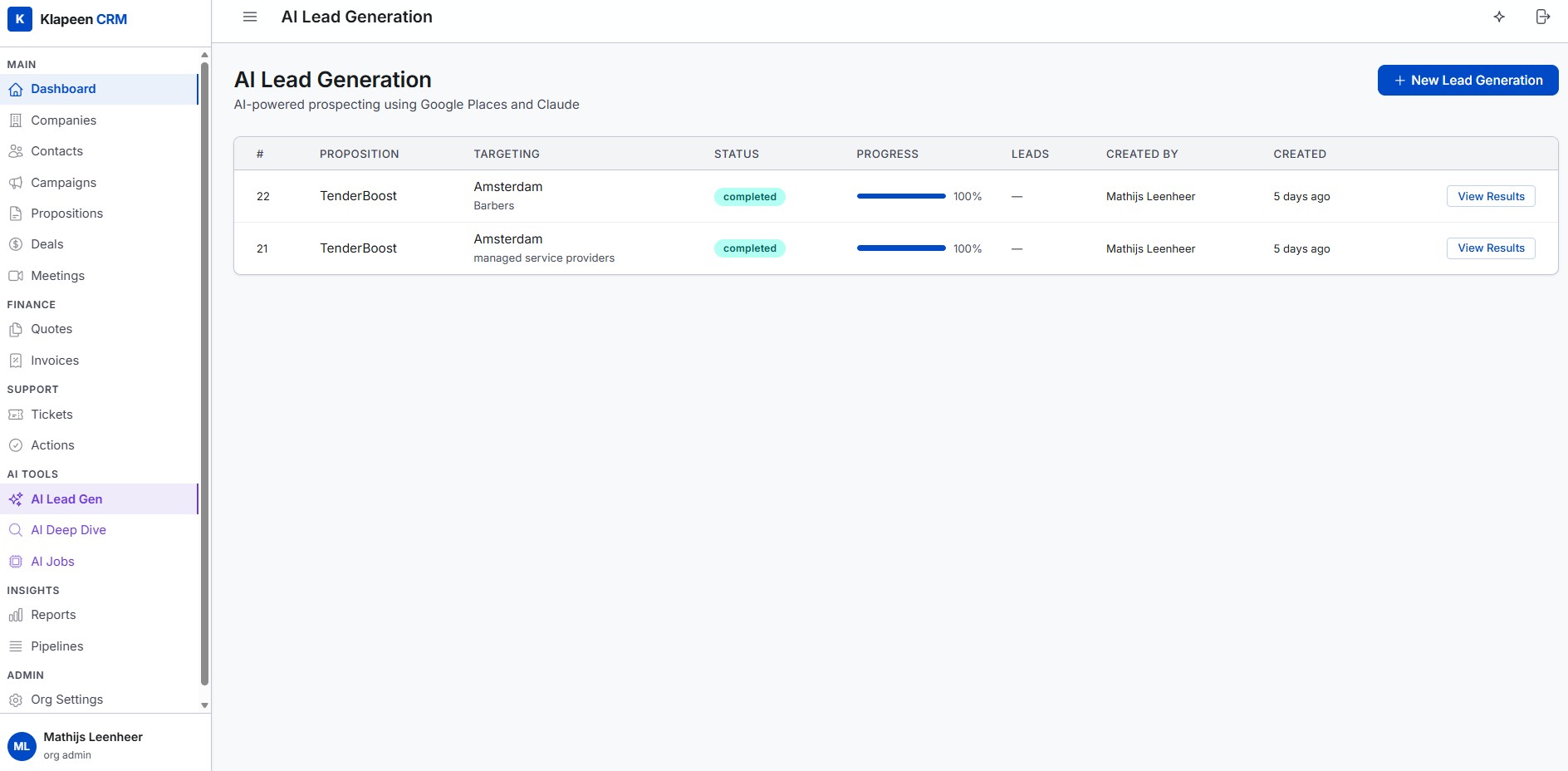
Generating leads from scratch. Need net-new prospects? Tell the system a vertical, a city, and a radius — “accountancy firms within fifteen kilometers of Utrecht” — and it goes and finds them. It pulls candidate companies from public business data, visits their websites, reads them, and structures what it finds into clean records: company name, contact persons, contact details. You review the list and keep what’s useful. What used to be an afternoon of manual research becomes a few minutes of reviewing.
Deep-diving a target on demand. Before an important call, you want to walk in knowing who you’re talking to. Select any company and the system builds a full intelligence picture: what they do, their products, recent signals worth knowing, the likely decision-makers, and — crucially — a suggested angle for your proposition specifically, with the sources to back it up. It’s the research a good salesperson would do if they had an extra hour for every account.
Capturing what was actually said. After a meeting, the real work is remembering it accurately. Drop in a recording or paste an existing transcript, and the system produces a concise summary, pulls out the decisions and the action items, and lets you turn those straight into tasks on the deal. Nothing important quietly falls through the cracks between calls.
Underneath all four, the same principles hold. The heavy AI work runs in the background, so you’re never staring at a frozen screen — you watch progress arrive live and results stream in as they’re ready. And because we route each task to the right-sized model rather than throwing the most expensive option at everything, the AI stays genuinely affordable to run. Cost-awareness isn’t an afterthought; it’s part of the design.
In our first test campaign, the system reduced preparation time from hours to minutes.
Improvement loops
We do not rely on one model for everything. Klapeen<CRM uses multiple AI models, each applied where it performs best — from fast extraction and classification to deeper research, reasoning, and language generation.
Practicing what we preach
Building our own CRM taught us more about AI-native software than any client project could have, because we were the ones living with every decision. It sharpened how we think, and it’s now the system we run our own business on every day.
That’s the point. We don’t recommend approaches we haven’t tried ourselves. If you’re looking at your own creaking spreadsheets and wondering whether AI could carry more of the load, that’s exactly the conversation we like to have.
Curious what AI-native software could do for your business?
Get in touch (https://www.klapeen.nl) — we’d be glad to show you what we built, and talk about what you we could build with you.